


Your tiles are out of fashion, worn out, and you’re tired of your bathroom floor being so cold? We present you the three methods that exist to replace your old tiles.
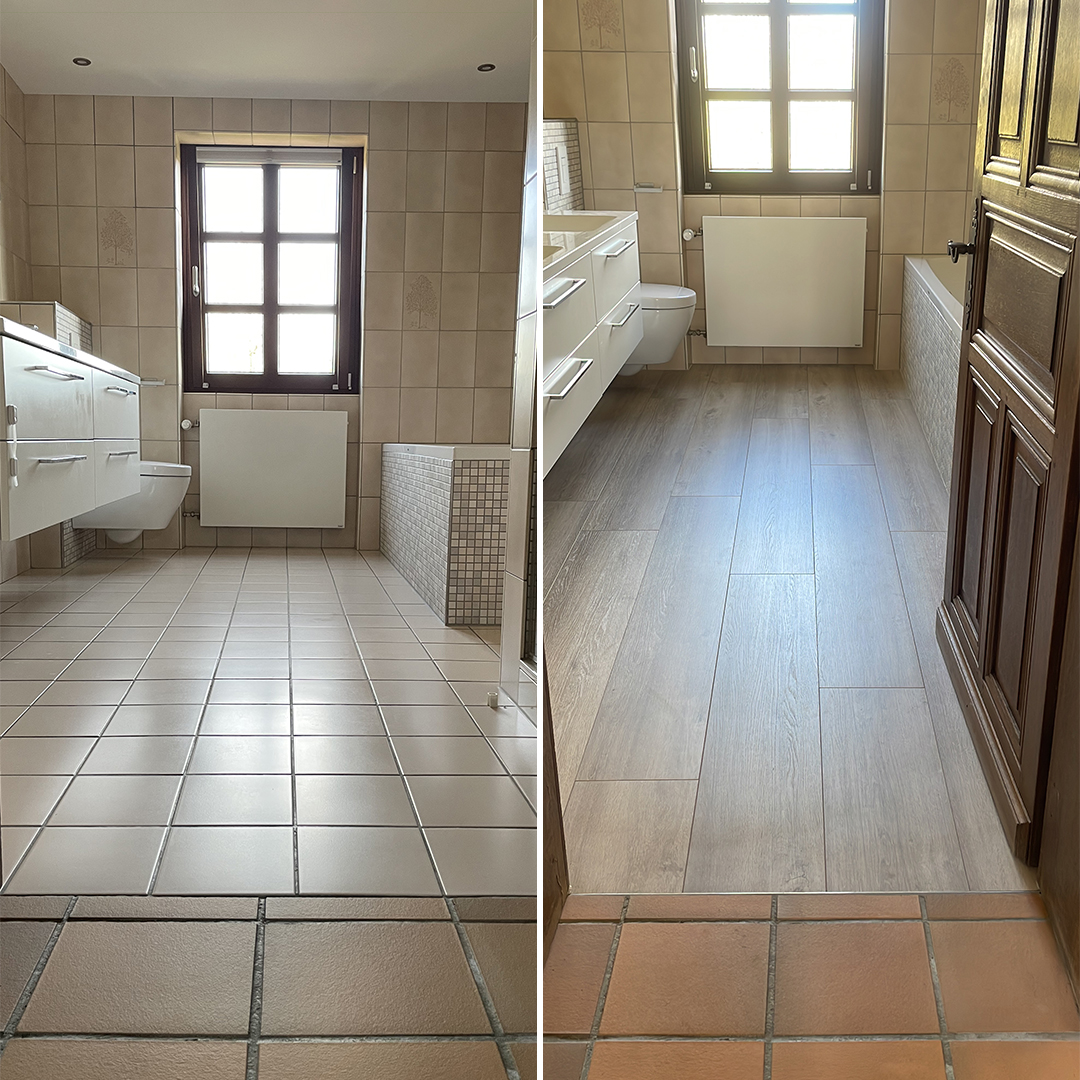
1 – Glued installation:
A +/- 2.5mm thick floor covering will be glued on the tiles. This process does not allow you to go back and get your tiles back, as with the floating installation that we discuss at the end of this article. This option is only possible if the tile is not hollow and there is no risk of it coming off.
Before gluing this new flooring, some preparation work is required. Its purpose is twofold: 1 – To cover the floor with a layer of self-leveling compount that will level the floor and make small reliefs and defects in the tiles disappear. 2 – To be able to install the floor covering at the same level as the tiles in the next room. To do this, you need to remove a part (about 1 m²) of the tiles behind the doors.
In addition to avoiding a difference in level at the doors, this method has the advantage of avoiding major work, such as tearing out all the tiles in the room.
Here are a few photos showing the steps on a job we recently did.
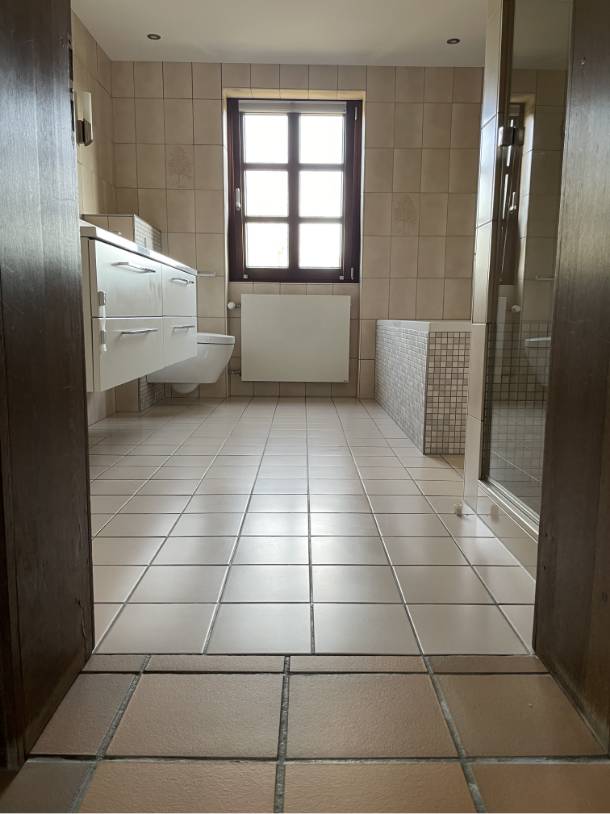
View of the room at the beginning of the work.
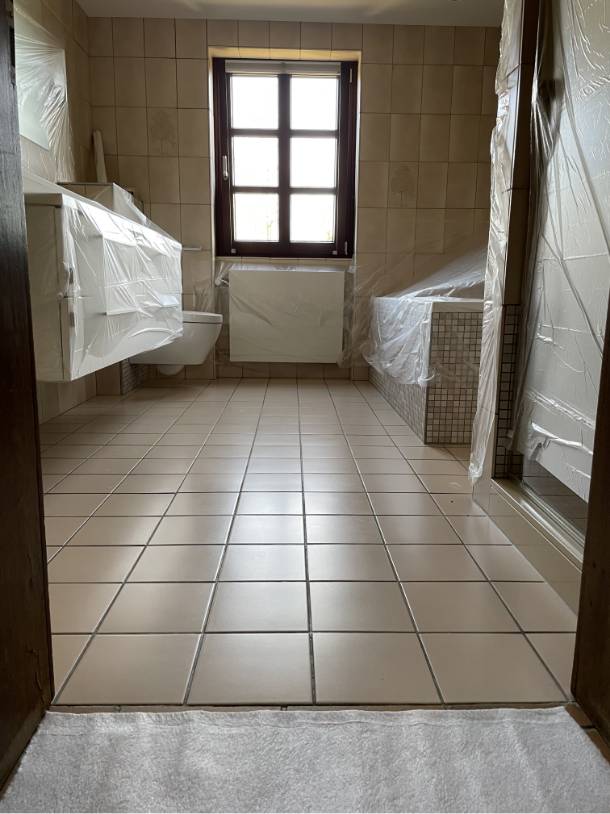
1st step: installation of the protections. The furniture that could be moved was moved.
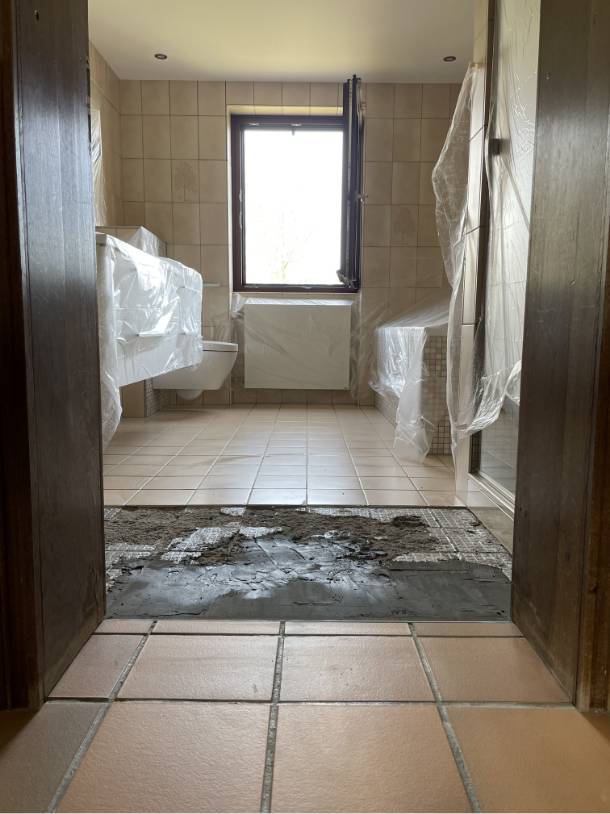
Removal of approximately 1 m² of tiles at the level of the door.
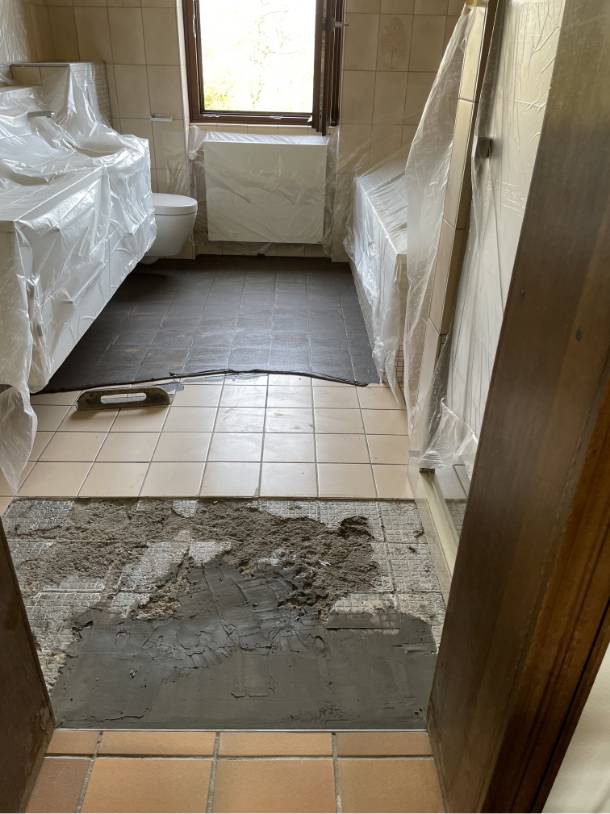
We proceed to fill the joints between the tiles before the self-leveling compound.
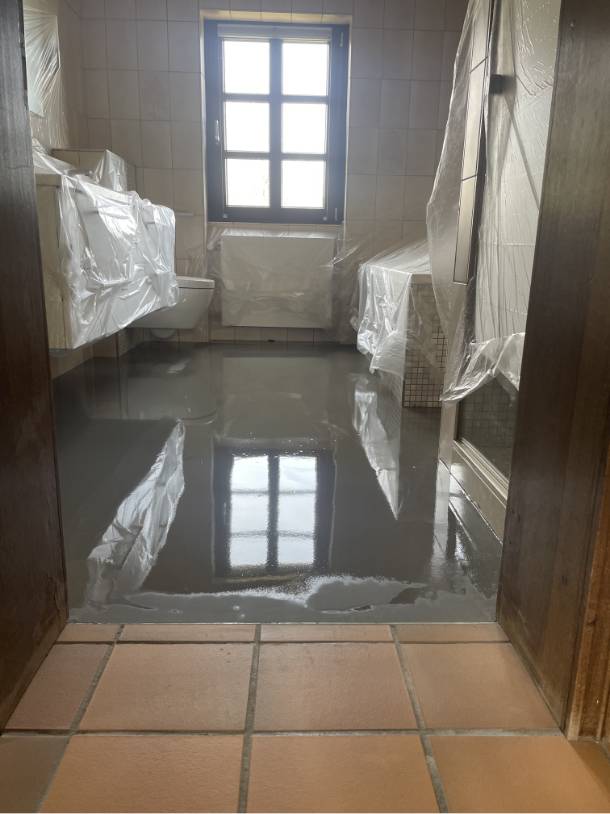
The next step is to apply a self-leveling compound to even out the floor. It is then necessary to count a time of drying of 12 hours before being able to lay the floor covering.
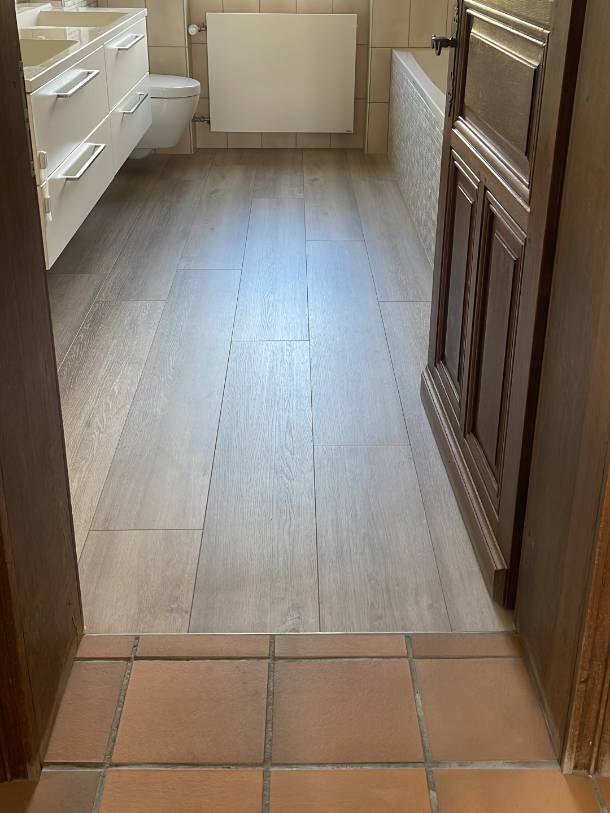
That’s it! Isn’t it beautiful?
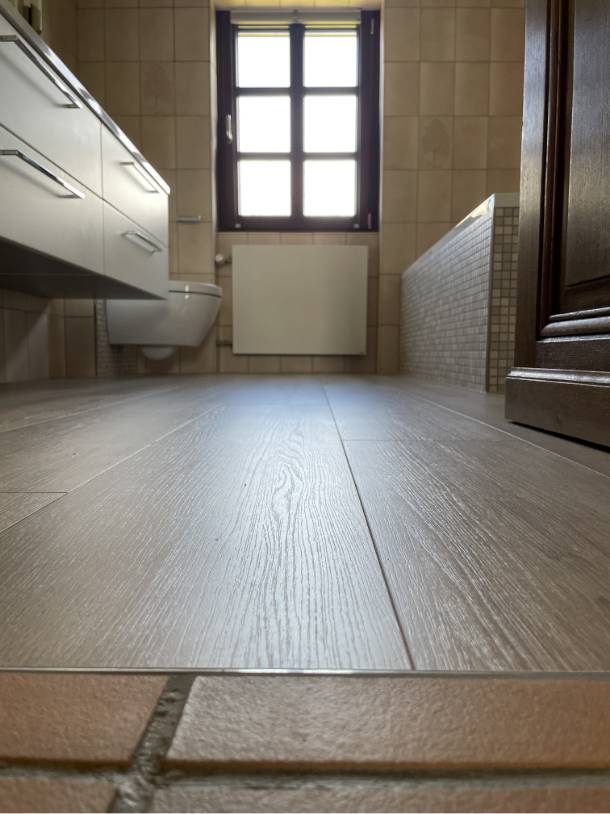
Note that there is no visible difference in level at the doorway.
With this type of intervention, the installation can be done flush with the existing baseboards. For aesthetic reasons, it is possible to glue pieces of the new flooring (+/- 2.5 mm thick) onto the existing tile baseboards or to replace them with wood baseboards.
Which floor covering should I choose for glued installation?
The choice is vast, for example lino, Purline organic flooring, vinyl but also rubber flooring. In addition to the material, choose the new optics that imitate tile, stone or wood.
2 – Tear out the tile:
There is really no need to give more details about this process, it’s all in the title.
de Buedemleër takes care of everything. We protect the elements that cannot be moved, we move the others (e.g. furniture), we tear out the tiles, we repair the screed and we put on top of it the new parquet or other floor covering chosen by the customer. Of course, once all this is done, we put the furniture back in place and we get rid of all the waste from the site, respecting the recycling instructions for each category of product.
This process allows the installation of any type of wooden flooring and other floor covering.
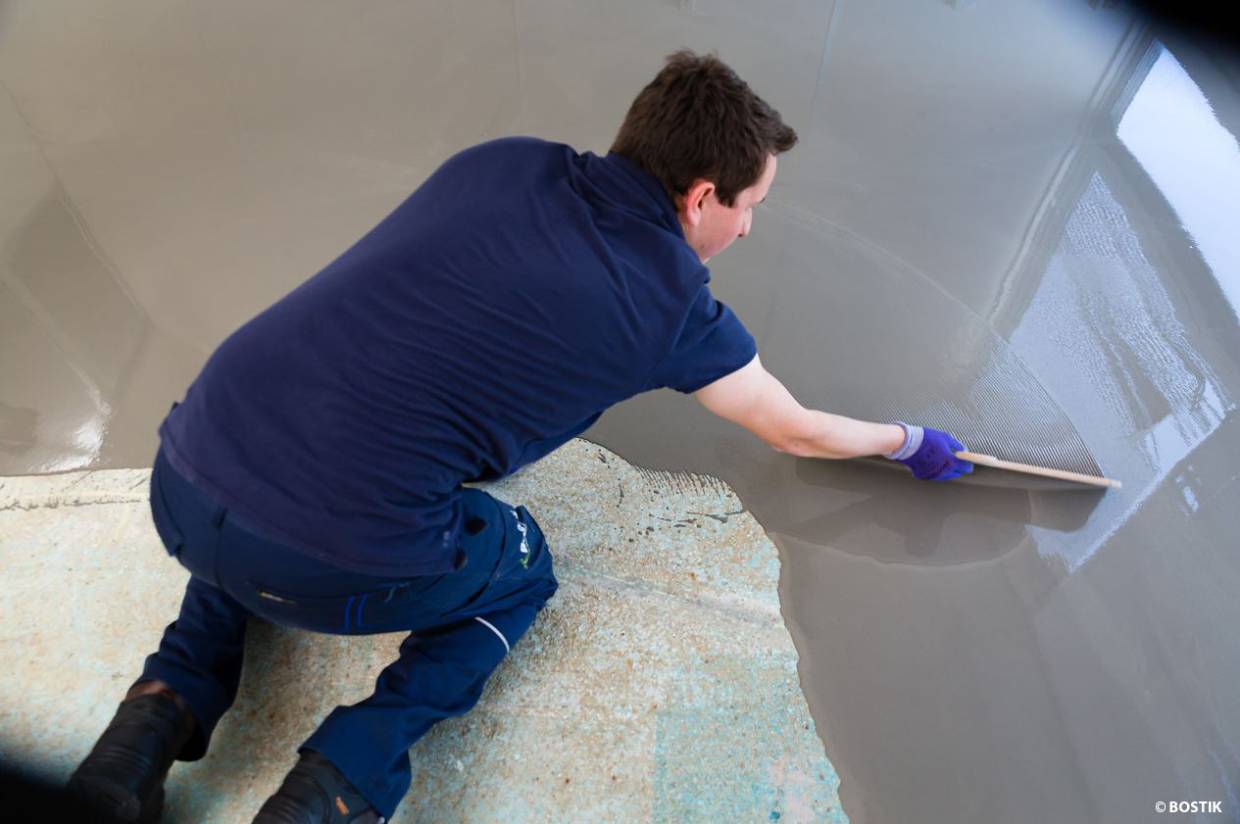
Application of self-leveling compound
3 – Floating installation on tiles.
With floating installation, the new floor covering is simply laid on top of the old tiles, no layer of levling compound, glue or other coating is applied to it.
Here are the main advantages and disadvantages of this process:

- This is the fastest and most economical installation technique;
- It is possible to keep the furniture in a room during the installation (even if it is necessary to move it);
- As there is no use of glue, it will be possible to go back to the original tiles.

- This installation will raise the height of the floor by 1-2 centimeters, so it is necessary to add a transition profile between the rooms and to plane the doors;
- If you choose to install a parquet floor, there will be an expansion joint along the walls, in which case it is likely that the baseboards will have to be changed;
- A parquet floor laid directly on tiles sounds a bit hollow.
Which flooring should you choose for floating installation?
There are many possibilities: laminate flooring, Purline organic flooring, cork tiles, vinyl flooring, carpet tiles, and even (within certain limits) repositionable tiles called “Loose Lay”. For more information on the different types of flooring compatible with floating installation, we suggest you visit our site or ask us for advice.
You have a project?